
Planning to buy a property in Bangalore? Congratulations! It’s a big decision—and an even bigger responsibility. But before you celebrate with a key handover or housewarming party, there’s a crucial legal step you simply can’t afford to skip: sale deed registration.
This isn’t just another formality or a stack of legal paperwork. The registered sale deed is your official proof of ownership, the one document that makes your purchase legally valid and protected under Indian law.
Without it, your ownership claim may not hold up in court, and your investment could be at risk. In this easy-to-understand guide, we’ll walk you through everything you need to know about sale deed registration—what it is, how to do it, what documents you need, how much it costs, and the biggest mistakes to avoid.
Let’s make your property journey smooth, secure, and stress-free, starting with the proper knowledge.
What is a Sale Deed?
Simple Definition of a Sale Deed
A sale deed is a legal document that officially records the transfer of ownership of a property from the seller to the buyer. It is a binding agreement that confirms that the buyer has paid the agreed amount, and the seller has handed over the legal rights to the property.
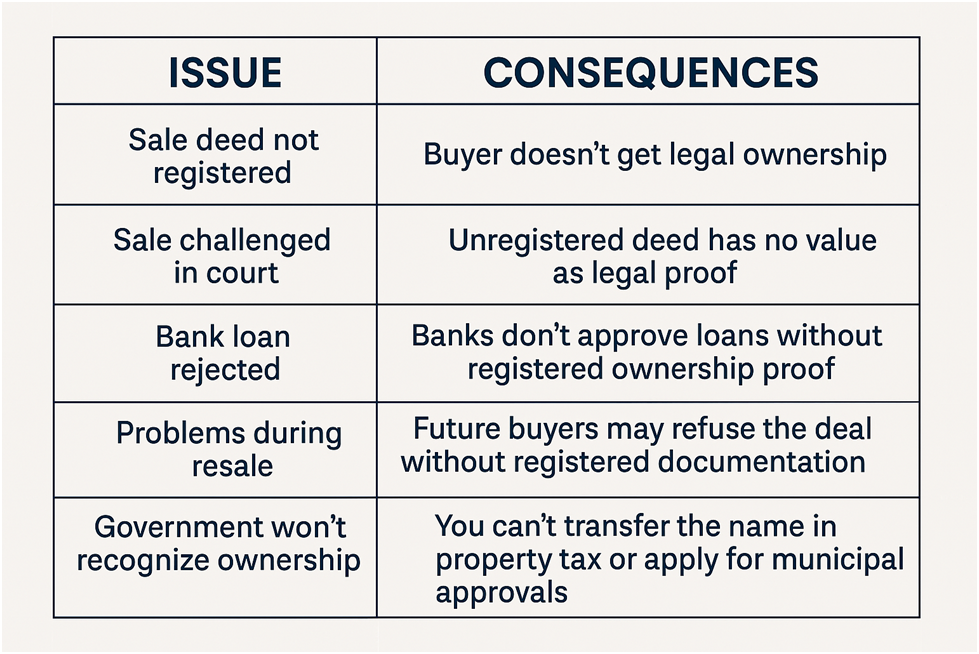
This document includes crucial details like the property description, sale amount, date of transfer, and signatures of both parties. Once executed and registered, the sale deed becomes the final proof of ownership and holds legal weight in any dispute or legal proceedings. Without a registered sale deed, the buyer cannot claim full ownership of the property, even if payment has been made.
Why It’s Legally Crucial in Real Estate Transactions
- Establishes Legal Ownership
The sale deed is the ultimate document of proof that a buyer legally owns the property. It overrides previous agreements like booking forms, letters of intent, or an agreement to sell. In legal and government records, the name on the sale deed is recognized as the lawful owner of the property.
- Enables Full Rights Transfer
Beyond just stating who owns the property, a sale deed transfers all legal rights, interests, and claims from the seller to the buyer. This includes the right to sell, lease, mortgage, or modify the property in the future. Without this transfer, the buyer may face legal obstacles while trying to use or sell the property.
- Future-Proofs Against Disputes
A registered sale deed protects the buyer from fraud, double-selling, or ownership claims by third parties. It becomes a key document in court if there’s ever a dispute regarding ownership. It also helps when applying for home loans, legal verifications, or in the event of resale.
What is Sale Deed Registration?
Meaning and Legal Requirement
Sale deed registration is the legal process of recording a property sale with the local government authority to make it official in public records. It serves as proof that ownership has legally changed hands from the seller to the buyer.
Under the Registration Act, 1908, it is mandatory to register a sale deed for any transaction involving immovable property valued over ₹100. Without registration, the document holds no legal validity in the eyes of the court, and the buyer does not receive enforceable ownership rights.
Once registered, the sale deed becomes a permanent legal document and can be used as proof of title in future legal or financial transactions related to the property.
Who Must Register and Why
Buyer’s Legal Obligation:
The responsibility for registering a sale deed primarily lies with the buyer, as it is in their interest to secure legal title to the property. Registration is what transforms the buyer from a prospective owner to the lawful owner in government records. Without it, the buyer may face challenges in selling, mortgaging, or transferring the property later.
Seller’s Role:
The seller must also be physically present during the registration process to confirm the transfer of ownership through biometric verification and signature. The seller’s cooperation is essential in ensuring the sale deed gets executed correctly and is free from disputes or false claims.
Joint Ownership Scenarios:
In cases where there are multiple buyers or sellers, all parties must be present at the time of registration. This ensures that each individual’s consent is recorded and acknowledged, which becomes essential in future transactions or legal matters involving co-owners or heirs.
Real-Life Example: Buying an Apartment in Bangalore
Let’s say you’ve decided to purchase a 2BHK apartment in Whitefield, Bangalore, worth ₹75 lakhs. After finalizing the sale, your lawyer drafts the sale deed and calculates the applicable stamp duty and registration fee based on Karnataka’s guidance value.
You and the seller schedule an appointment at the Sub-Registrar’s Office. On the day of registration, both parties are required to carry ID proofs, PAN cards, and passport-sized photographs. The original documents are verified, biometrics (fingerprints and photos) are captured, and the final deed is signed in the registrar’s presence.
Once the process is complete and the fees are paid, your sale deed is digitally scanned, stored, and officially recorded. You receive a registered copy, which acts as your legal proof of ownership.
Table: Parties Involved in Sale Deed Registration
| Party | Role/Responsibility | Legal Significance |
| Buyer | Pays stamp duty, initiates registration, and signs deed | Gains legal ownership after registration |
| Seller | Signs and verifies the property transfer | Confirms transfer of title to the buyer |
| Witnesses (2) | Present during signing, confirm identities | Adds legal authenticity to the transaction |
| Registrar Office | Verifies, records, and stores the sale deed | Provides legal recognition and enforceability |
Step-by-Step Process of Sale Deed Registration in Bangalore
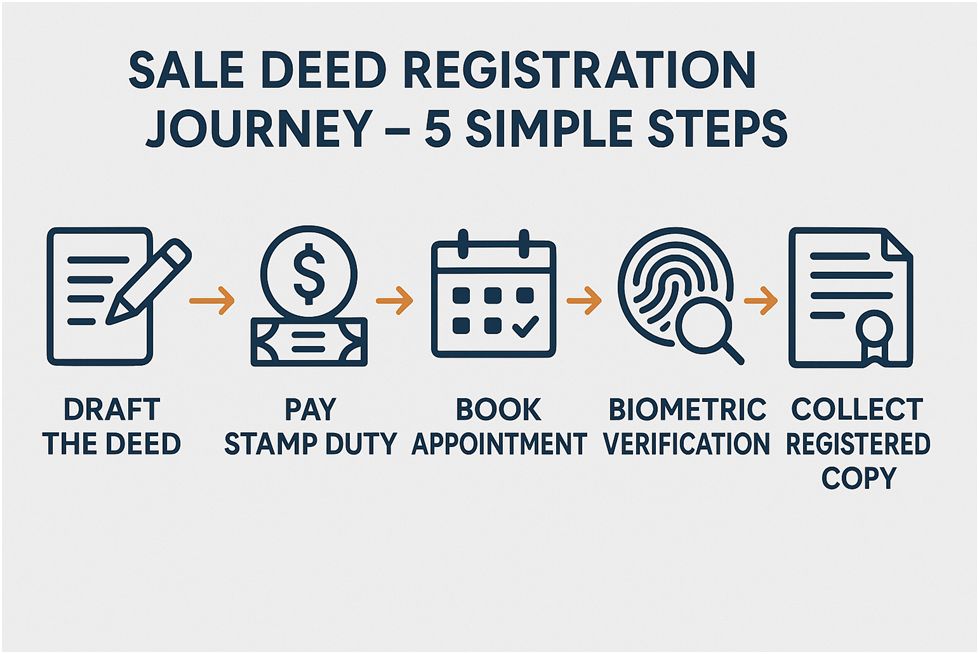
Understanding how the sale deed registration works will help you stay prepared and avoid legal issues. Here’s how the process unfolds in 5 straightforward steps:
Step 1: Drafting the Sale Deed
The first step is to draft the sale deed, which is a legal document outlining the terms of the property sale. This includes details like buyer and seller information, property description, sale amount, payment terms, possession date, and applicable charges. A lawyer or legal advisor usually prepares the draft to ensure it complies with local property laws and reflects the true intention of both parties.
Step 2: Stamp Duty and Registration Fee Payment
Once the draft is ready, the next step is to calculate and pay the stamp duty and registration fee. These charges vary by state and are usually a percentage of either the guidance value or the sale price, whichever is higher. The payment is made online through the state government’s portal or via authorised banks. Make sure to keep the e-challan or receipt as proof of payment.
Step 3: Appointment at Sub-Registrar’s Office
After the fees are paid, you’ll need to book an appointment with the Sub-Registrar’s Office in the jurisdiction where the property is located. The slot is usually booked online, and you will be given a date and time to appear with all required documents, including the drafted sale deed, ID proofs, and payment receipts.
Step 4: Identity Verification and Biometrics
On the day of the appointment, both the buyer and the seller must be physically present. The registrar will verify all documents, and both parties will go through a biometric process—fingerprint scanning and a photograph. This step ensures that the transaction is genuine and that both parties are willingly entering into the agreement.
Step 5: Final Signatures and Document Collection
Once identities are verified, both the buyer and the seller sign the final copy of the sale deed in the presence of two witnesses. After the registration is completed, the registrar’s office provides a receipt and a digital copy of the registered sale deed. The hard copy is either handed over immediately or made available for collection in a few days.
Required Documents for Sale Deed Registration
Sale deed registration involves more than just signing a paper—it requires both the buyer and seller to present a set of official documents to ensure the transaction is legal, transparent, and complete.
Missing even one required document can cause delays or even rejection at the registrar’s office. Here’s a complete list for both parties, along with important supporting documents often overlooked.
For Buyers
Buyers must present documents that verify their identity, financial compliance, and legal eligibility to buy the property.
Here are the key documents required from the buyer:
- Government-issued photo ID (Aadhaar Card, Passport, Voter ID, etc.)
- PAN Card (mandatory for transactions over ₹50,000)
- Two recent passport-sized photographs
- Address Proof (Utility bill, Driving License, etc.)
- Payment Proof (bank statement or payment receipt showing full/part consideration)
- Sale Agreement Copy, if executed earlier
- Loan Sanction Letter (if property is financed)
For Sellers
Sellers need to prove ownership of the property and verify their identity for the title transfer to take place legally.
Documents needed from the seller include:
- Original Title Deed / Mother Deed
- Government-issued photo ID (Aadhaar, PAN, Passport, etc.)
- Two passport-sized photographs
- Encumbrance Certificate (to show no legal dues on the property)
- No Objection Certificate (NOC) from the housing society or builder
- Possession Letter and/or Allotment Letter (if applicable)
- Latest Property Tax Receipts
Additional Documents
Certain property transactions may require additional supporting documents, especially in special circumstances like power of attorney cases, under-construction properties, or resale of builder flats.
Here are some commonly required additional documents:
- Power of Attorney (POA) – If the property is being sold or bought through an authorized representative
- Encumbrance Certificate (EC) – To confirm the property is free from legal/financial liability
- Occupancy Certificate (OC) – Particularly for apartments or builder floors
- Completion Certificate (CC) – For newly constructed buildings
- Sanctioned Building Plan – Needed in most urban property transactions
- GST Invoice or Receipt – If applicable in builder-purchased properties
Document Checklist for Sale Deed Registration
| ✅ Buyers | ✅ Sellers | ✅ Additional Documents |
| ☐ Aadhaar Card / Valid Photo ID | ☐ Aadhaar Card / Valid Photo ID | ☐ Power of Attorney (if applicable) |
| ☐ PAN Card | ☐ PAN Card | ☐ Encumbrance Certificate (EC) |
| ☐ Address Proof (utility bill, etc.) | ☐ Original Title Deed / Mother Deed | ☐ Occupancy Certificate (OC) |
| ☐ Passport-sized Photographs (2) | ☐ Passport-sized Photographs (2) | ☐ Completion Certificate (CC) |
| ☐ Payment Proof (Bank receipt) | ☐ NOC from Society/Builder | ☐ Sanctioned Building Plan |
| ☐ Copy of Sale Agreement (if any) | ☐ Latest Property Tax Receipts | ☐ GST Invoice (if purchased from the builder) |
| ☐ Loan Sanction Letter (if financed) | ☐ Possession Letter / Allotment Letter | ☐ Builder-Buyer Agreement (in case of under-construction property) |
Cost of Sale Deed Registration
Stamp Duty Charges by State
Stamp duty is a state-imposed tax that buyers must pay when registering a property. It is calculated as a percentage of the property value—either the guidance value or the market value, whichever is higher.
Since stamp duty rates vary by state, location plays a huge role in determining how much you’ll spend during registration. Additionally, some states offer concessions to women buyers or for first-time homeowners. Stamp duty is non-refundable and must be paid before or during the registration process to ensure the sale deed is legally valid.
Registration Fee Breakdown
Apart from stamp duty, buyers must also pay a registration fee, which is usually 1% of the total property value (subject to a maximum limit, depending on the state). This fee is paid to the Sub-Registrar’s Office for officially recording the sale deed in government records.
For example, in Karnataka, if your flat costs ₹75 lakhs, the registration fee would be ₹75,000. In some states, like Maharashtra, the registration fee may be capped (e.g., ₹30,000 for urban areas).
Miscellaneous Charges
In addition to official government charges, there are miscellaneous costs that buyers should account for:
- Legal fees for drafting the sale deed (₹5,000–₹15,000 depending on the lawyer)
- Notary charges for certifying supporting documents (₹500–₹1,000)
- Document handling or facilitation fee if using a third-party service (₹2,000–₹5,000)
- Misc. expenses like photocopies, stamp papers, courier, etc.
These costs may seem small individually, but can add up, so it’s wise to plan your total budget accordingly.
Table: State-wise Stamp Duty & Registration Charges (Updated 2025)
| State | Stamp Duty | Registration Fee | Women Buyer Discount |
| Delhi | 6% (men), 4% (women) | 1% of property value | Yes (2% lower than men) |
| Maharashtra | 5% in urban areas | 1% (max ₹30,000) | Yes (1% lower for women) |
| Karnataka | 5% (above ₹35L), 3% (₹21–35L) | 1% of property value | No |
| Tamil Nadu | 7% flat rate | 1% of property value | No |
| Uttar Pradesh | 7% for all | 1% of property value | Yes (rebate of ₹10,000 max) |
| Telangana | 7.5% total (incl. surcharge) | 0.5% of property value | No |
Note: Rates are indicative and subject to change. Always verify on the official state registration portal.
Common Mistakes to Avoid During Registration
Even a minor oversight during the sale deed registration can lead to costly delays or legal trouble later. Here are five common mistakes you should be careful to avoid:
1. Skipping Name/Address Verification
Many buyers forget to double-check the spelling of their name or residential address in the sale deed. A small error—like a missing letter or incorrect apartment number—can cause issues with property tax records, utility bills, or even in future resale. Always cross-verify the details with your identity documents before signing anything.
2. Using Incorrect Property Measurements
Inaccurate measurements of the property—whether it’s the carpet area, built-up area, or land size—can lead to legal complications or disputes with the seller or authorities. Make sure that the dimensions mentioned in the sale deed match those in the approved building plan and government records.
3. Not Verifying Seller’s Ownership
Buyers sometimes assume the seller owns the property just because they present documents. But unless you check the title deed, encumbrance certificate, and mutation records, you could end up buying disputed property or one with pending litigation. Always conduct title verification with a legal expert.
4. Ignoring Pending Dues
If the seller has unpaid property taxes, water bills, or housing society dues, those liabilities may fall on you once the property is transferred. Always ask for No Dues Certificates before proceeding with registration. It saves you from surprise bills and unnecessary hassle after moving in.
Legal Consequences of Unregistered Sale Deeds
Sale Deed vs Agreement to Sell vs Title Deed
Understanding the difference between a Sale Deed, an Agreement to Sell, and a Title Deed is essential in any property transaction. While they may seem similar, each document serves a distinct purpose in the legal transfer of property ownership. Let’s explore how they differ and when each one is used.
What Makes Them Different
A Sale Deed is the final and legally binding document that confirms the actual transfer of property ownership from the seller to the buyer.
An Agreement to Sell is a preliminary contract where both parties agree on the future sale of a property under specific terms and conditions.
On the other hand, a Title Deed is proof of ownership, usually derived from a registered sale deed or earlier legal documents showing the property’s ownership history.
Each serves a unique function in a property transaction cycle and must not be confused with the others.
When to Use Each Document
Use an Agreement to Sell during the early negotiation phase when the buyer and seller agree to a sale, but it hasn’t been finalized. It’s helpful in securing terms while awaiting legal clearances, financing, or documentation.
Once all conditions are met, and payment is completed, a Sale Deed is executed and registered, marking the official transfer of ownership.
A Title Deed, often used in loan applications or legal proceedings, comes into play after the sale deed is registered. It acts as proof that the person in possession is the lawful owner of the property.
Legal Enforceability
A registered Sale Deed is fully enforceable in court and considered conclusive proof of ownership.
An Agreement to Sell is not enforceable for ownership transfer but may be used to seek specific performance if either party defaults.
A Title Deed is legally recognized as evidence of ownership and is often used in resale, inheritance, or legal disputes.
However, its enforceability depends on how it was derived, usually from the most recent registered sale deed.
Comparison Table: Sale Deed vs Agreement to Sell vs Title Deed
| Feature | Sale Deed | Agreement to Sell | Title Deed |
| Purpose | Final transfer of property ownership | Promise to sell in the future | Proof of ownership post-registration |
| Stage of Use | After full payment and legal clearance | Before final payment and legal checks | After the sale deed registration |
| Is Registration Required? | Mandatory under law (Registration Act, 1908) | Not mandatory, but recommended | Not a separate document—derived from the registered sale deed |
| Legal Enforceability | Fully enforceable in court | Partially enforceable for conditions | Used as evidence of ownership |
| Grants Ownership? | Yes | No | Yes (only if based on a valid registered deed) |
Quick Summary for Busy Buyers
In a rush? No worries—we’ve got your back.
Here’s a quick 5-step breakdown of the sale deed registration process, along with one helpful tip per step to help you avoid delays and surprises.
Sale Deed Registration at a Glance
Step 1: Draft the Sale Deed
Have the sale deed professionally drafted by a lawyer or use a vetted legal template to ensure accuracy.
Tip: Double-check names, property details, and payment terms to avoid rejections later.
Step 2: Calculate and Pay Stamp Duty
Stamp duty is calculated based on either the market value or the guidance value—whichever is higher.
Tip: Visit your state’s registration portal to get the exact amount using online calculators.
Step 3: Book an Appointment at the Sub-Registrar’s Office
Choose a convenient date and time at the jurisdictional office where the property is located.
Tip: Arrive 30 minutes early with original documents, IDs, and two witnesses.
Step 4: Attend Registration and Complete Biometric Verification
Both parties sign the document in front of the registrar, along with thumb impressions and photos.
Tip: Ensure all co-owners or power of attorney holders are present with valid IDs.
Step 5: Collect the Registered Sale Deed
Post-registration, the office scans and uploads the document; you receive the certified copy.
Tip: Store both digital and physical copies safely—it’s your legal proof of ownership.
This TL;DR is designed to save you time, reduce confusion, and give you quick confidence as you move through your property transaction.
FAQs About Sale Deed Registration in Bangalore
Is a sale deed valid without registration?
No, a sale deed is not legally valid without registration. As per the Registration Act, 1908, all transactions involving immovable property above ₹100 must be registered. Without registration, the buyer cannot claim legal ownership, and the deed will not be admissible in court in case of a dispute.
Can I register a sale deed online?
While you cannot fully register a sale deed online, many states like Karnataka, Maharashtra, and Delhi allow partial digital processes. You can calculate stamp duty, fill out e-forms, and book appointments online via the state’s official registration portal. However, physical presence at the Sub-Registrar’s Office is mandatory for biometric verification and final execution.
What if I lose my original registered sale deed?
If you lose your original registered sale deed, don’t panic. You can apply for a certified copy at the local Sub-Registrar’s Office where the property was registered. This copy is legally valid and can be used in place of the original for most legal purposes. Always keep digital scans or photocopies as backups.
How long does registration take?
The actual registration process usually takes a few hours on the scheduled day. However, document preparation, stamp duty payment, and appointment booking can take 3–5 working days in total. Once completed, you will receive a digitally signed copy within a few days to a couple of weeks, depending on the state’s system.
Can a sale deed be cancelled after registration?
Yes, a registered sale deed can be cancelled, but only under specific legal grounds like fraud, coercion, or mutual consent. The cancellation must be done through a registered cancellation deed and may require a court order if one party disagrees. It is advisable to consult a property lawyer for this process.
Final Thoughts: Make Your Sale Deed Count
Registering your sale deed is more than just a formality—it’s a legal shield that protects your property rights. Without it, your ownership has no standing in the eyes of the law. A registered sale deed ensures that your investment is officially recorded and can be confidently used in future transactions, bank loans, or legal claims.
Property transactions involve complex legal language and financial implications. It’s always wise to consult a trusted legal expert or property lawyer before registration. They can help verify documents, confirm title ownership, and ensure your sale deed is free from errors or future disputes. A small legal check today can save you significant headaches tomorrow.
For buyers in Karnataka, sale deed registration is managed through the Kaveri Online Services portal. You can calculate stamp duty, book registration slots, and access key documents online.

Leave a Reply